
Targeting quality
Clinical Chemistry, Monthly (CCM)
An ISO/IEC 17043-accredited program for routine clinical chemistry.
Intended use
CCM monitors the accuracy of both manual techniques and assays on automated clinical chemistry analyzers. Any laboratory working in routine clinical chemistry and dealing with human specimens can participate. The program gives an independent and confidential external assessment of each laboratory's performance, together with a simultaneous comparison of the methods in use in participating laboratories.
It is a 12-month scheme of 12 vials (rounds): one vial is analyzed and its results submitted every month. You can enrol in any quarter.
Samples

Human-based lyophilized 5 ml serum samples with chemical additives and tissue extracts of human and animal origin. Samples are prepared as closely as practicable to match the matrix, measurands and concentrations of patient specimens. You choose a box that covers a quarter, half a year or the full year.
The 28 analytes
- Albumin
- ALP
- ALT
- Amylase
- AST
- Bilirubin, D
- Bilirubin, T
- Calcium
- Chloride
- Cholesterol, Total
- CK, Total
- Creatinine
- GGT
- Glucose
- HDL-C
- Iron
- LDH
- LDL-C
- Lipase
- Magnesium
- Phosphate
- Potassium
- Proteins, Total
- Sodium
- TIBC
- Triglyceride
- Urea
- Uric acid
Procedure
- Each month, one sample is analyzed according to the unique date printed on its label.
- Any combination of the 28 analytes can be measured in any sample.
- Treat samples like patient specimens and run them according to the instructions of the instrument, kit or reagent in use.
- Submit results electronically, in the participant portal, before the “Submit Before” date printed on each vial.
- Report results with the same number of significant figures or decimal places you use for patient results.
- It is recommended to analyze each sample within two weeks of its deadline.
- If a result exceeds the linear range of your method, handle the sample according to your established procedure. Do not report results as more than (>) the linearity limit.
Entering your results
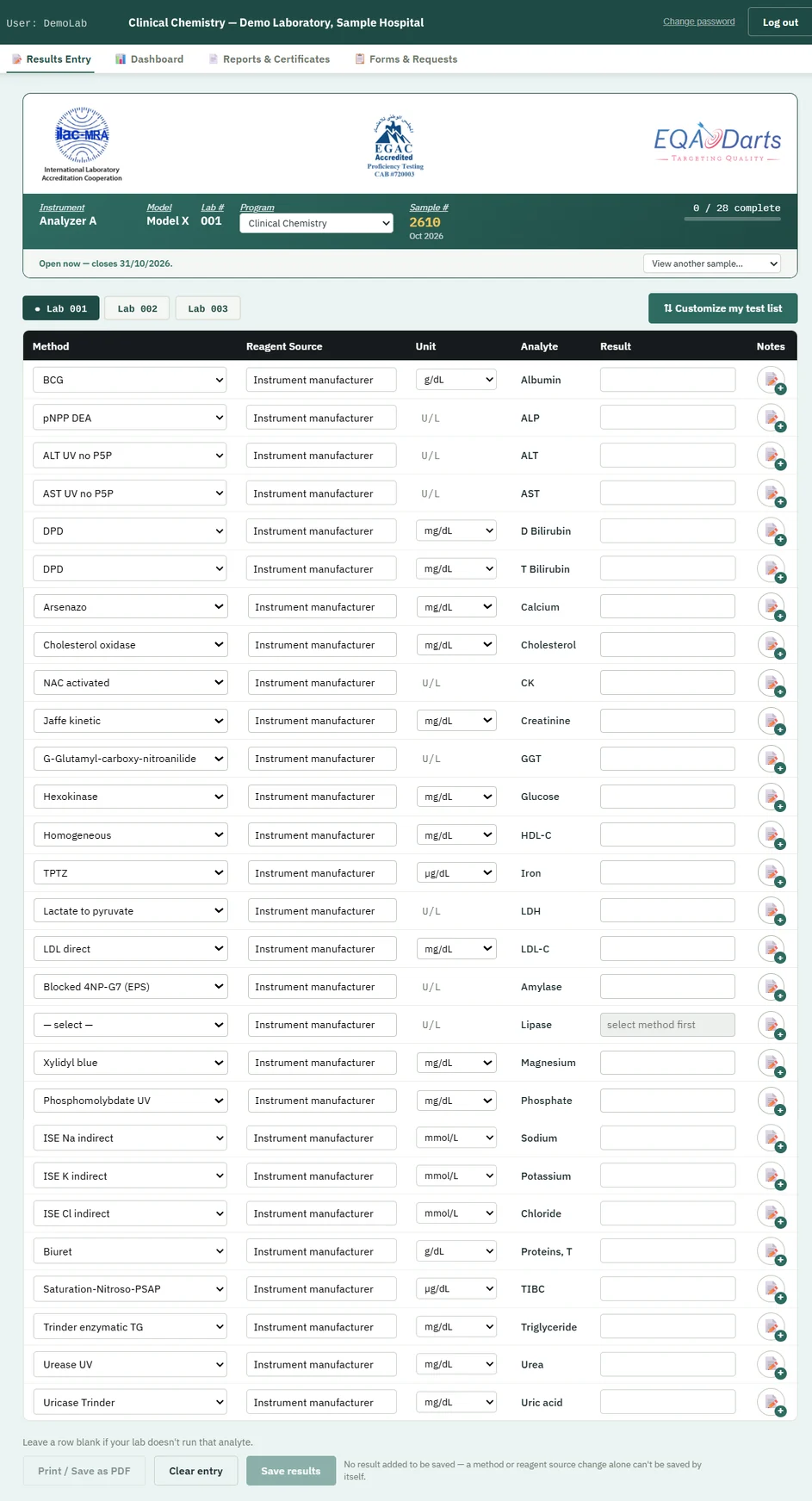
Results are entered on one screen in the participant portal. Choose your method and reagent source, check the unit, and type a result for each analyte your laboratory runs. Leave the others blank.
Design, implementation and data analysis
- Design, implementation and data analysis follow ISO/IEC 17043 and ISO 13528.
- Assigned values and their uncertainties are consensus values from participant results. Analysis is done at three levels: all participants (“All Methods group”), participants using the same method (“Method group”) and participants using the same instrument/method combination (“Peer group”).
- Whenever possible, a participant is evaluated against its Peer group, the most homogeneous subset, provided the group has at least 5 participants. The comparison group is shown for each analyte in the “Comparator” column of the report. If there are fewer than 5, performance is compared to the next larger group with at least 5 participants: the Method group, then the All Methods group.
- Robust analysis (Algorithm A, ISO 13528 Annex C) is used to calculate target means and standard deviations.
- The standard deviation for proficiency assessment is a robust estimate of the standard deviation of the results reported by all participants.
Confidentiality
EQA Darts maintains a high respect for participant confidentiality. To protect each participant's identity, every laboratory is identified by a unique code known only to EQA Darts and the participant.
Schedule
| Sample | Month | Lot | Submit before |
|---|---|---|---|
| 2601 | Jan 2026 | CCM 1026-01 | 25/01/2026 |
| 2602 | Feb 2026 | CCM 1026-02 | 25/02/2026 |
| 2603 | Mar 2026 | CCM 1026-03 | 28/03/2026 |
| 2604 | Apr 2026 | CCM 1026-04 | 25/04/2026 |
| 2605 | May 2026 | CCM 1026-05 | 25/05/2026 |
| 2606 | Jun 2026 | CCM 1026-06 | 25/06/2026 |
Each vial also carries its own “Submit Before” date, and participants see their deadlines in the portal.